Composer: Georg Muffat (b. 1659 - d. 1704)
Performance date: 27/06/2015
Venue: St. Brendan’s Church
Composition Year: 1682
Duration: 00:11:01
Recording Engineer: Richard McCullough, RTÉ lyric fm
Instrumentation Category:Small Mixed Ensemble
Instrumentation Other: 2vn,va,vc, db, lute, hpd
Artists:
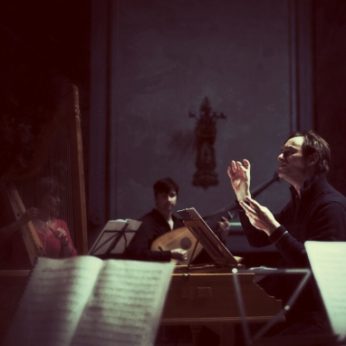
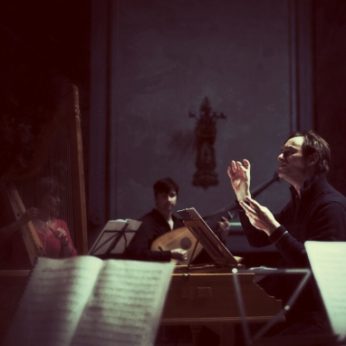
Arcangelo (Sophie Gent, James Toll [violins], Rebecca Jones [viola], Sarah McMahon [cello], Tim Amherst [bass], David Miller [lute], Jonathan Cohen [harpsichord,director]) -
[baroque ensemble]
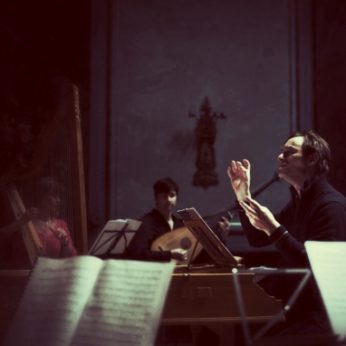
Georg Muffat was born in 1659 in Megeve, Duchy of Savoy and although he considered himself German he was of Scottish descent. He was a true European in the modern sense – from the age of ten until sixteen he studied music in Paris with Jean-Baptiste and then worked as an organist in both Molsheim and Seléstat. In 1674, he travelled to Bavaria to study law and then spent some time in Vienna before moving to Prague. He worked in the service of the Archbishop of Salzburg, Maximilian Gandolph, count of Kuenburg, for almost ten years before finally settling in Passau in 1690. Here he spent the rest of his days as Kapellmeister to the court of bishop Johann Philipp von Lamberg until his death in 1704.
In 1680 Muffat received permission from the count of Kuenburg to travel to Rome in order to continue his musical studies with the great harpsichordist and organist Bernardo Pasquini. It was here that he met Arcangelo Corelli whose Concerti Grossi inspired him to compose the five chamber sonatas for ’few or many instruments’ entitled the Armonico Tributo. The instrumentation of the sonatas is open, giving the performer free rein to use from as little or as many instruments as they please. The sonatas comply with any particular musical form; each one contains between five and seven movements, and they combine elements of the church sonata with dance movement forms. Sonata No.5 is particularly different from the other four in that it opens with an expressive Allemanda.
Sonata No.5 concludes with a brilliant Passacaglia which reflects Muffat’s studies with Lully. It consists of a magnificent twenty-five variations on a standard ground bass, closely related to that of Bach’s Goldberg Variations. The Passacaglia is re-used by Muffat in a slightly modernised form at the end of his twelve Concerti Grossi in 1701.
Copyright © 2026 West Cork Music. All rights reserved.
Designed and developed by Matrix Internet
